"By maximizing quality,” says Dr. Andy Galpin, “you get to worry less about being perfect with your quantity."

So far, this series has helped us metabolize and share the standouts from a groundbreaking 2022 metabolomics report by the Van Vliet Lab at Utah State University, one that measured Maui Nui against more than 200 beef samples from across the country.
The findings drove home how much more of the good stuff (plant antioxidants and balanced omegas) and how much less of the bad (oxidative stress) are found in this incredible wild food source.
This month, we turn to an expert in human performance to see what he zooms in on.


Dr. Andy Galpin, professor, scientist and host of the Perform Podcast, made a return trip to Maui last month to Holo ʻAi with us, helping share food with community. Having him back called to mind a conversation we had in 2024, after he had pored over Van Vliet's profiling of our samples.
The biggest takeaway from that talk story, that not all protein is created equal, rings just as relevant two years on.
QUALITY VS. QUANTITY
Andy talked about food as two dials. One is quantity, the calories you take in. The other is quality, what those calories do for you. Input and output.
Many of us hyperfocus on the first dial, especially around protein, and we worry much less over the details of dial #2. His term for where that can lead us is hard to forget: undernutriented.
And his fix isn't to crank the quantity dial to max. It is to maximize our caloric budget, getting more nutrients out of every calorie.
"By maximizing quality,” says Andy, “you get to worry less about being perfect with your quantity."
—
WHAT "QUALITY" MEANS IN PROTEIN
We spent Vol. 2 looking at Leucine, the amino acid that flips on your muscle-building switch. Here is Andy on why it sits at the center of the quality story:
"Leucine is the primary driver of skeletal muscle growth. As long as you get enough Leucine, the total amount of protein you eat doesn't matter that much for muscle growth. This is why you'll often hear people differentiate 'quality' protein from non-quality."
And where Maui Nui lands:
"Maui Axis deer have an enormous amount of Leucine, meaning their venison will drive muscle growth exceptionally well, making it far easier to hit your Leucine threshold."

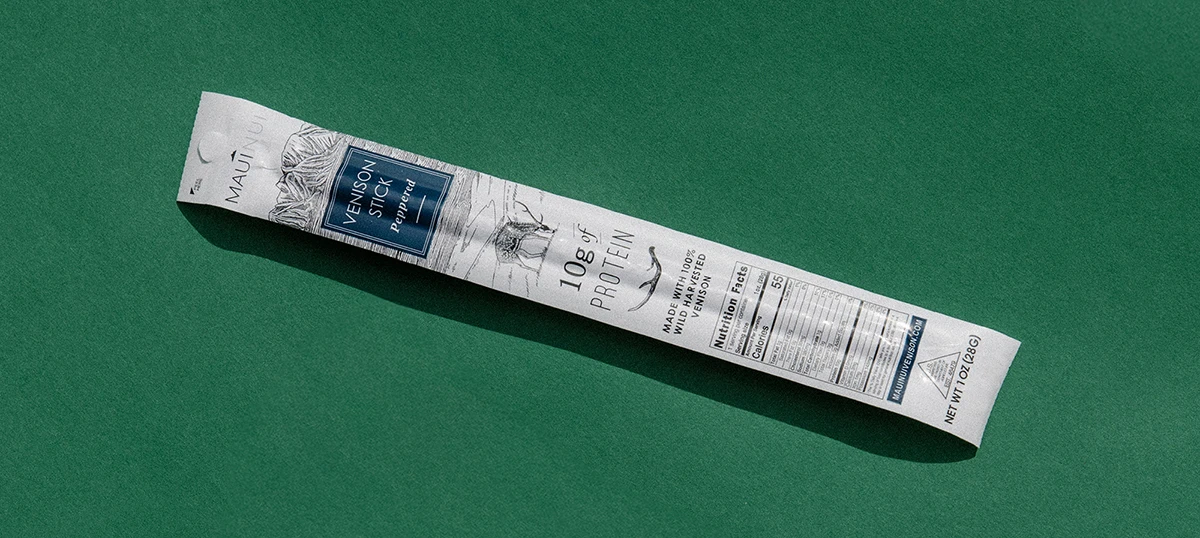
That’s 22% more leucine in Maui Nui than in grass-fed beef.* Which means you can clear that threshold while cutting calories, or while eating less total protein overall. Take a 165-lb Maui Nui snack subscriber, for example. Three Peppered Sticks (165 calories) is all it takes to clear the threshold for them. The leading grass-fed beef stick takes four sticks and roughly 400 calories to do the same job. Same signal, less than half the caloric cost to send it.
"Protein is always the hardest thing for people to get enough of. Solving for this will dramatically improve muscle growth and recovery."
—
WHAT ELSE CAUGHT HIS EYE
Beyond Leucine, we asked what else jumped out to Andy from the report.
The finding he calls most jarring is the one we spotlighted last Volume, the Omega 3:6 ratio, now in the words of someone who measures it for a living:
"One of the biggest challenges of a standard western diet is the overconsumption of Omega 6 fatty acids and the simultaneous underconsumption of Omega 3 fatty acids. I've personally tested the Omega 3:6 ratio in countless people's blood, and it's almost always poor.
Maui Nui has, by a country mile, the best Omega 3:6 ratio I've ever seen, and it is multiple times better than even grass-fed beef."
Then he pointed to two nutrients most of us never think to look for, both significantly higher in Maui Nui:
- Vitamin A (retinol): 5x more than grass-fed beef.
- Choline: 1.5x more than grass-fed beef.
"The venison's Vitamin A and Choline concentrations are particularly interesting to me, as they play an important role in everything from eye function to brain health, and are often overlooked."
His explanation for this nutrient-density arrives exactly where this series keeps landing. It comes down to how the animal lived:
"These animals live an incredibly low-stress life. These factors combine to give the animal vastly superior protein, phytochemical, and fatty acid profiles, with significantly lower oxidative stress markers."


A healthier animal, a healthier food source. We keep arriving at the same sentence from every direction.
And reading about how different this protein is from other red meats is one thing, but getting MORE IN to your own diet is where you feel the difference.
We set out to help find a better balance for Maui's deer populations. What we keep finding is a food full of surprises, and sometimes we get lucky enough to have amazing people around who help us better understand them.
Mahalo to Andy for volunteering his time for Holo ʻAi and lending his voice to our More in Maui Nui series.
There is so much more in Maui Nui. We'll be back next month.
Ā hui hou,
The Maui Nui Venison ʻOhana
Full conversation with Dr. Andy Galpin, Professor and Scientist of Human Performance, host of the Perform Podcast. *Amino Acid comparisons: Van Vliet Lab Metabolomics Report, Utah State University, 2022.